A fast, AI-readable website in 2026: the few things that matter
A slow site loses twice: it loses the people, who leave before they ever see it, and it loses the AIs, which can’t read it well enough to cite it. The good news: in 2026, “fast” and “AI-readable” are the same job — and a handful of the right moves is enough.
Between the click and the page appearing, there’s a silence. In that silence, your prospective customer decides whether you’re worth the wait. Most of them don’t wait: they hit back and pick the result below yours.
Speed isn’t just an SEO factor: it’s sales, trust, and visibility inside the AIs. In 2026, “a fast site” and “a site the AI can read” are the same thing: clean HTML that shows up instantly, without having to run heavy JavaScript first. If a page is slow or muddled, you lose it with people and with AI assistants at the same time.
How fast does a site actually need to be in 2026?
Google uses three thresholds — the Core Web Vitals — as its bar for “good”: LCP (how long the main content takes to load) under 2.5 seconds, INP (how quickly the page responds to a click) under 200 ms, and CLS (visual stability) under 0.1 (Google, Core Web Vitals documentation). Since March 2024, INP has replaced the old FID: responsiveness counts for more than it used to, and sites weighed down by too much JavaScript pay for it.
What does a slow site really cost you?
Customers. Every extra second of waiting drops conversions by roughly 7%, and 53% of mobile users abandon a page that takes more than 3 seconds to load (Google data). The other way round: in Google and Deloitte’s “Milliseconds Make Millions” study (2020), an improvement of just 0.1 seconds lifted retail conversions by 8.4%. This isn’t a technical footnote: it’s revenue walking in or walking out.
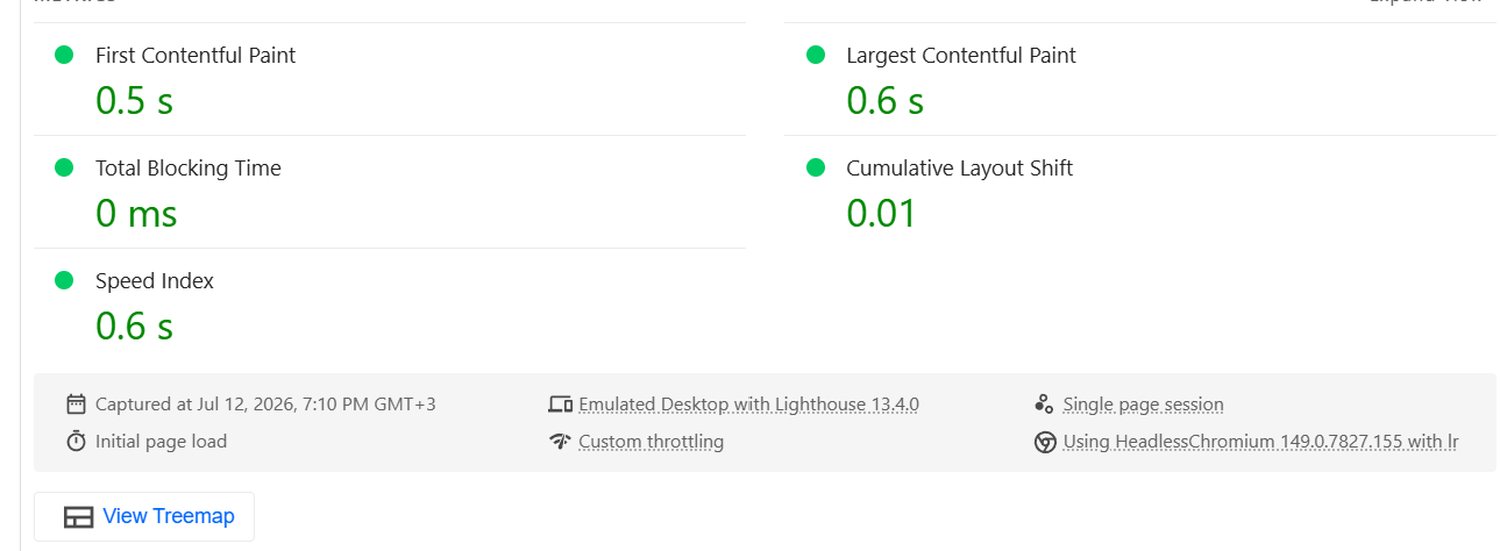
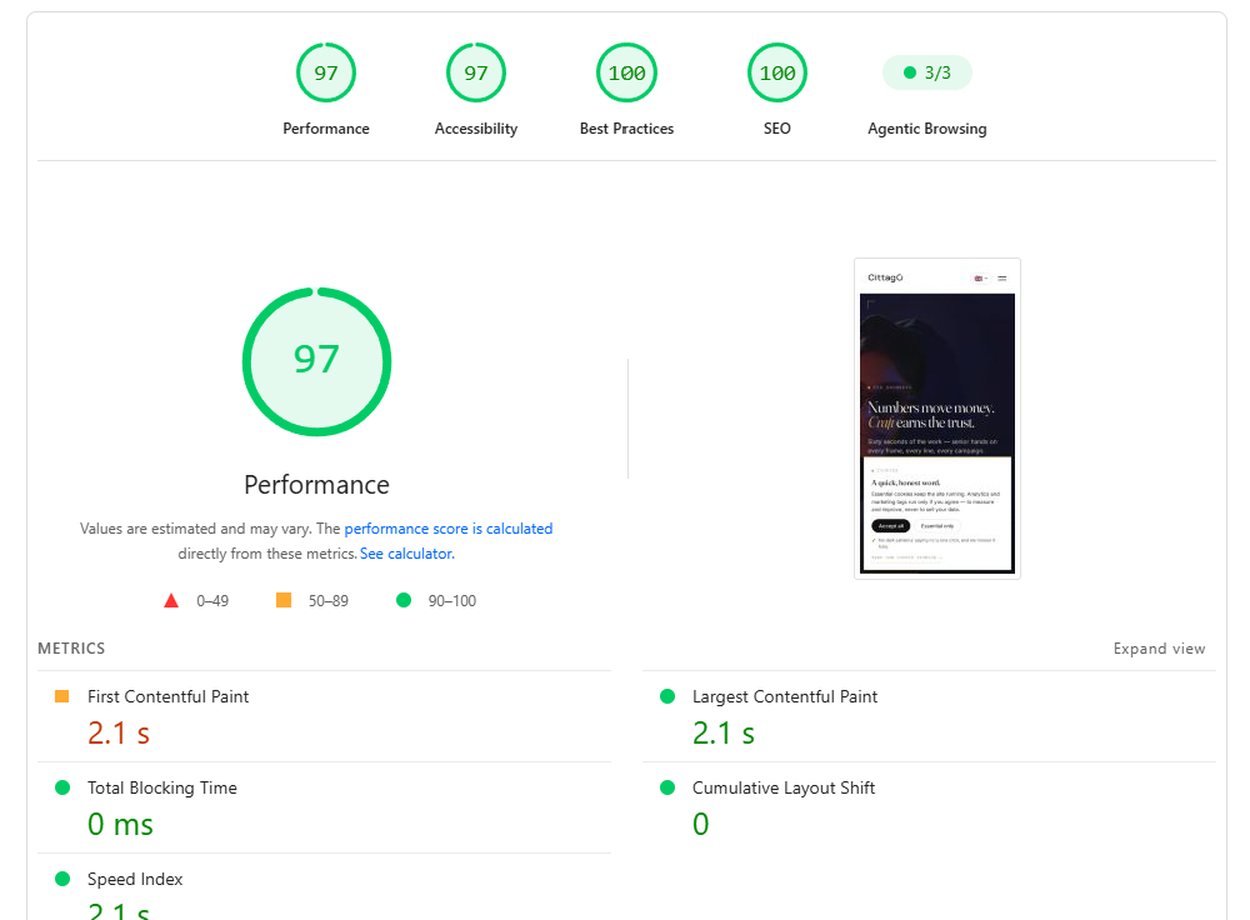
These aren’t marketing numbers: this is our own site, measured on PageSpeed Insights. You can verify it in thirty seconds — paste your address into Google’s free tool or try our speed test tool. Whatever score comes back is your starting line.
What does the AI need in order to read your site?
The same thing that makes it fast: clean HTML, served right away. The crawlers behind ChatGPT, Claude, and Perplexity don’t run JavaScript (log analysis, Vercel, 2025): if your content only shows up after the site “loads” through heavy scripts, then as far as they’re concerned it simply isn’t there — and they can’t cite you. A fast, well-structured site is also a site the AIs understand. That’s the bridge to GEO, optimizing to be found by AI assistants.
How do I make it fast without rebuilding everything?
You rarely need to rebuild the site. In order of payoff:
- Serve ready-made HTML. Content that’s visible without waiting for JavaScript. Static sites start with a head start; for the rest, you trim the non-essential script and defer what’s left.
- Lighter images + a CDN. Modern formats, the right dimensions, and delivery from a server close to the visitor (see Cloudflare, below).
- Caching at the server level. An engine like LiteSpeed does the same work far faster and “remembers” the responses it has already computed.
- Redis for e-commerce and dynamic sites. A shop with a cart, filters, and prices hammers the database constantly: Redis holds the most-requested answers in memory, so pages stay fast even under load. It’s the pairing we recommend for e-commerce.
- Fewer third-party scripts. Every widget, chat, and pixel adds weight. Keep only the ones that genuinely earn their place.
How do you know if you’re already fast?
Measure, don’t guess. Once a month: run your key pages through PageSpeed Insights, watch LCP, INP, and CLS, and make sure they’re in the green on mobile (where Google judges first). If a number slips after an update, you know exactly where to look. A pattern we see all the time in small and medium businesses (SMBs): a site that launched fast, then quietly filled up with plugins and scripts over the years until it crawls — and nobody notices until sales dip.
Frequently asked questions
Does speed still matter for Google in 2026?
Yes. Core Web Vitals are still a ranking signal, and the mobile version is the one Google judges first. But in 2026, speed is also the price of admission for being read by the AIs.
Do I really have to rebuild the site?
Almost never. Most of the problems get solved on images, caching, scripts, and hosting, without touching the design. You rebuild a site when the technical foundation is past saving — not to claw back half a second.
How much does speed optimization cost?
Far less than rebuilding everything. The first moves (images, caching, a free CDN) often take a few hours and show up in the score right away.
Can WordPress or WooCommerce actually be fast?
Yes, with the right server (LiteSpeed + Redis), serious caching, and a CDN out front. The problem is almost never the platform: it’s how it’s configured.
Is a free speed test still worth having on a website?
It is worth having if it remembers something. From 19 August 2026 Google has been rolling generated interfaces into AI Overviews, which means the model can build a small measuring tool inside the answer. What it cannot build is a record of your site over time, so a checker that only returns a number has a shorter future than one that keeps a history.
Which score should I actually watch: mobile or desktop?
Mobile, because that is the version Google judges first. The same page routinely scores twenty points higher on desktop, and the gap is not a bug — the two runs use different CPU throttling and a different network profile.
Does a good score guarantee good rankings?
No. Core Web Vitals are one signal among many, and a fast page about nothing still ranks for nothing. Speed removes a reason to lose; it does not supply a reason to win.
How often should the score be re-measured?
After every change that touches images, scripts or hosting, and otherwise monthly. Single runs vary by several points on the same page and the same minute, so a single bad reading is a prompt to measure again, not to start optimising.
Where Cittago comes in
Since 2011 we’ve been making sites fast for one simple reason: speed turns into customers. We do the unglamorous part properly — page speed optimisation in order of impact, a LiteSpeed server with Redis for e-commerce, and a Cloudflare CDN in front of it all — and we prove it with numbers. Measured again on 22 August 2026, our own homepage returns 99 for performance on desktop, with largest contentful paint at 0.8 s and 100 for both accessibility and SEO. Not luck, and not a perfect score either: a method, re-run.
A second of waiting is a door swinging shut. Speed isn’t a technical vanity: it’s the first thing the customer — and the AI — learn about you.
Last updated: 22 August 2026. The thresholds and the cost figures in this guide are unchanged since it was published on 12 July 2026. Added on this pass: four questions, including what changes now that Google has started generating measurement tools inside its own answers — covered in what generated interfaces do to tool pages. We will revisit the guide when Google next changes a Core Web Vitals threshold.